Carl Rogers and the Healing Power of Being Understood

Empathy, acceptance and authenticity in the person-centred approach
What helps people grow, understand themselves and make meaningful changes in their lives?
Is it advice? Guidance? Having someone tell us what we should do?
The American psychologist Carl Rogers believed that something more fundamental was needed: a relationship in which a person feels genuinely understood, accepted and free to be themselves.
His work transformed the way many people think about human relationships, counselling and personal development.
At the heart of his approach was a simple yet profound idea: people have an inherent capacity for growth, and the quality of the relationships around them can help that capacity unfold.
Who was Carl Rogers?
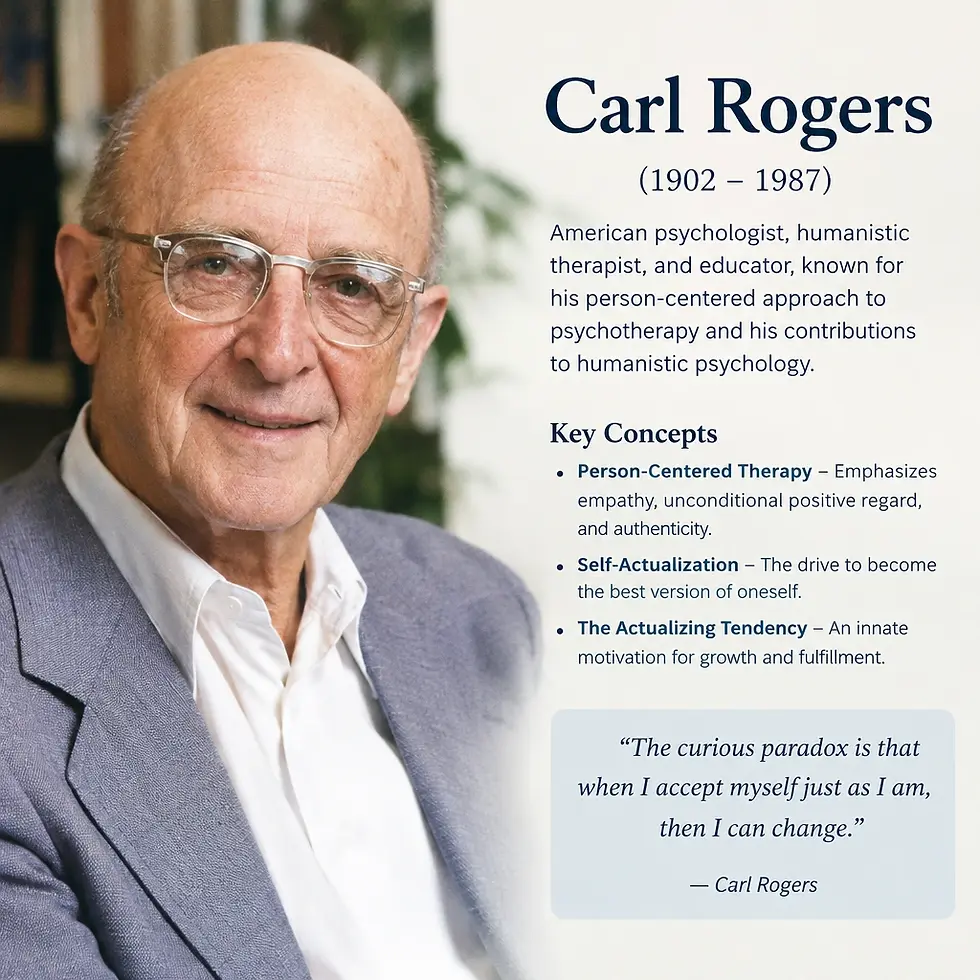
Carl Rogers (1902–1987) was an American psychologist and one of the most influential figures in humanistic psychology.
He developed what became known as Person-Centred Therapy, originally called Client-Centred Therapy.
Rather than seeing the therapist as an expert who directs the client's journey, Rogers placed the person at the centre of the process.
He believed that people have an innate tendency towards growth, development and self-understanding. He called this the actualising tendency.
However, this potential does not always have the conditions it needs to flourish.
Fear of judgment, expectations, criticism and the pressure to meet other people's standards can make it difficult for us to accept ourselves and recognise what we truly feel.
Rogers suggested that a particular kind of relationship could help create the conditions for personal growth.
He identified three essential qualities.
1. Empathy: Understanding another person's world
For Rogers, empathy meant entering another person's inner world as if it were our own, while never losing the awareness that it belongs to someone else.
This distinction is important.
Empathy does not mean assuming that we know exactly how another person feels. It does not mean projecting our own experiences onto them.
It means making a genuine effort to understand their perspective.
We might not share someone's experience, but we can still be curious about what it means to them.
Instead of saying:
"I know exactly how you feel."
We might say:
"I wonder what this has been like for you."
Instead of immediately interpreting someone's emotions, we can give them room to describe their own experience.
Empathy requires openness, humility and a willingness to remain curious.
It is not about having the right answer. It is about trying to understand.
2. Unconditional Positive Regard: Accepting the person without judgment
The second essential condition in Rogers' approach is unconditional positive regard.
This means offering another person acceptance and respect without making their worth dependent on their behaviour, thoughts, feelings or choices.
It does not mean agreeing with everything someone does.
It does not mean abandoning our own values or personal boundaries.
Rather, it means recognising the person's inherent worth, even when we disagree with their actions or struggle to understand their decisions.
Imagine being able to speak about your fears, mistakes, doubts or difficult emotions without feeling that you have to defend your right to have them.
Imagine being accepted as a person, even when your experiences are complicated or uncomfortable.
Such acceptance can create a sense of psychological safety.
It allows people to explore themselves more honestly, without constantly worrying about how they will be judged.
3. Congruence: The importance of being genuine
The third condition is congruence, sometimes described as genuineness or authenticity.
Rogers believed that a helping relationship should not be based on pretending, performing or hiding behind a professional role.
Congruence means being genuine and internally consistent in the relationship.
It does not require us to be perfect, endlessly patient or to know exactly what to say.
We can acknowledge uncertainty. We can admit when we do not understand something.
We can remain honest while still being respectful and considerate.
Authenticity makes room for a real human encounter rather than an interaction based on expectations or appearances.
Listening as a way of honouring another person
What do these three conditions have to do with empathic listening?
Everything.
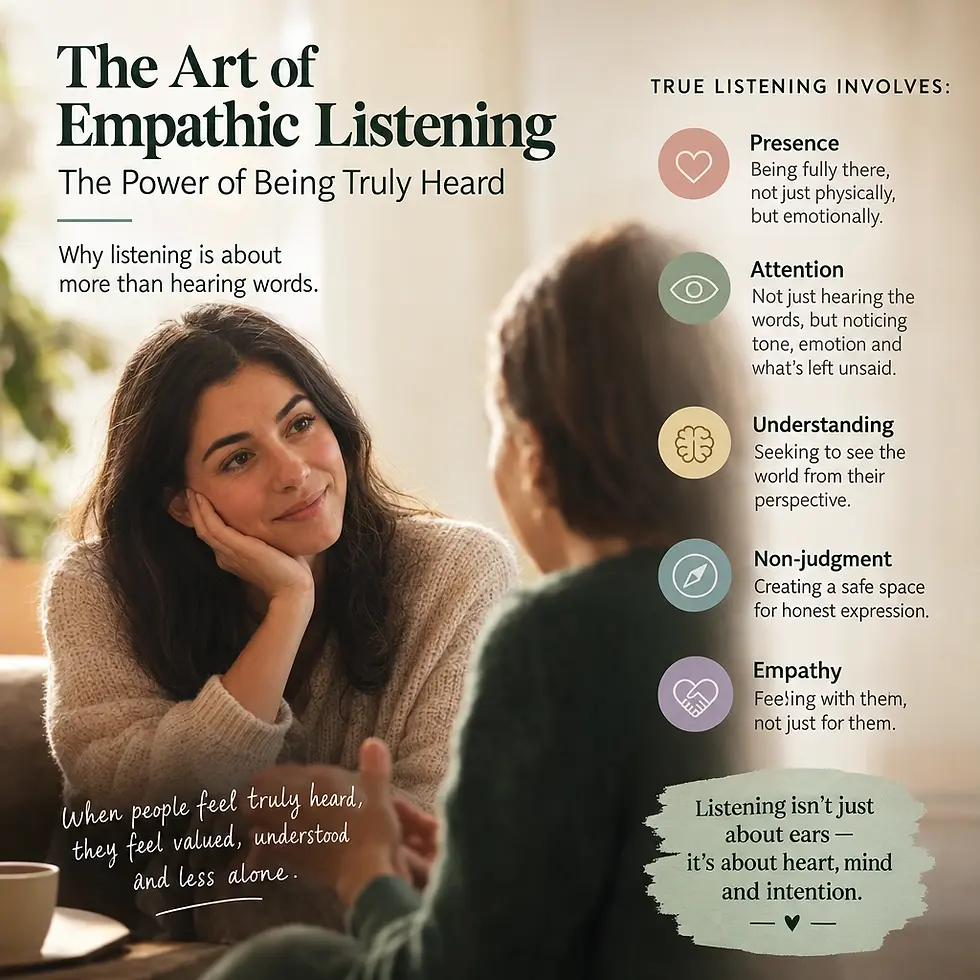
When we listen with empathy, we try to understand another person's experience.
When we listen with acceptance, we allow them to express themselves without unnecessary judgment.
When we listen authentically, we bring our genuine attention and humanity into the encounter.
Together, these qualities create the foundation for a meaningful relationship.
Rogers' approach reminds us that we do not always need to direct another person's process or provide answers.
Sometimes people need the freedom to discover their own.
The difference between helping and fixing
There is an important distinction between supporting someone and trying to fix them.
When we rush to offer advice, we may unintentionally take control of a process that belongs to the other person.
We may assume that we know what is best, even when we have not fully understood their experience.
A person-centred attitude asks something different of us.
Can we stay present without taking over?
Can we listen without immediately evaluating?
Can we trust that the other person has their own inner resources, even when they cannot yet see them?
This does not mean that support, guidance or practical help are never needed.
It means recognising that genuine support begins with understanding.
Bringing Rogers' ideas into everyday life
Although Rogers developed his approach within psychology and psychotherapy, many of his ideas can inspire the way we relate to people in everyday life.
We can practise them by:
Listening without interrupting or rushing to respond.
Being curious about another person's perspective.
Acknowledging feelings without minimising them.
Avoiding unsolicited advice.
Respecting differences in values and experiences.
Being honest about what we understand and what we do not.
Allowing people to find their own words, insights and solutions.
These are not simply communication techniques.
They reflect a deeper attitude towards other people: one based on respect, trust and recognition of their individuality.
A relationship in which growth becomes possible
Perhaps one of the most important lessons we can take from Carl Rogers is that meaningful change does not always begin with being told what to do.
Sometimes it begins when we encounter someone who is willing to understand us.
Someone who does not rush to judge.
Someone who does not need to have all the answers.
Someone who can stay present with our uncertainty, sadness, confusion or hope.
In such a relationship, we may gradually become more accepting of ourselves and more able to recognise what we truly need.
This is the spirit behind person-centred listening.
It is not about becoming the person who knows best.
It is about creating the conditions in which another person can hear themselves more clearly.
Perhaps the most meaningful thing we can offer someone is not the answer to their questions, but a relationship in which they feel safe enough to discover their own answers.
Inspired by the work of Carl Rogers (1902–1987).
Room for It is a space for reflection, understanding and human connection.
We don't always need answers. Sometimes, we need a little space to explore our thoughts, understand our emotions and feel less alone in our experiences.
Because everyone deserves a space where they can simply be themselves.
Comments