The Art of Empathic Listening: The Power of Being Truly Heard

Updated: 2 days ago
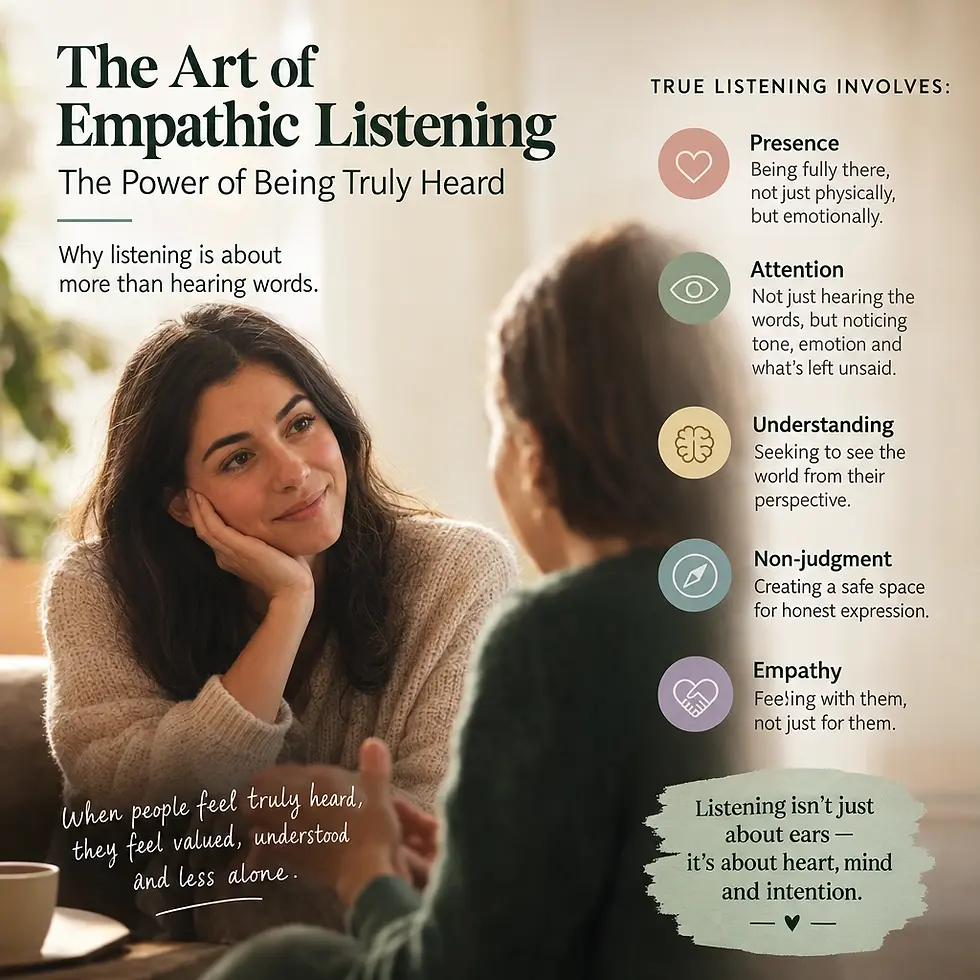
Why listening is about more than hearing words
Have you ever tried to share something important with someone, only to feel that they weren't really listening?
Perhaps they were already thinking about what to say next. Maybe they offered advice before you had finished speaking, tried to reassure you, or quickly turned the conversation towards finding a solution.
And have you ever experienced the opposite?
A conversation in which you felt completely at ease. Where you didn't have to explain yourself, defend your feelings, or pretend to be someone else. Where you could simply speak, knowing that the other person was genuinely present.
There is something deeply meaningful about being truly heard.
In a world where we are constantly communicating, sharing information and responding to one another, genuine listening can sometimes feel surprisingly rare.
Yet empathic listening is one of the simplest and most powerful ways we can connect with another human being.
Listening is more than hearing
We often think of listening as a natural part of communication. Someone speaks, we hear their words, and then we respond.
But empathic listening goes beyond this exchange.
It means being fully present with another person and making an effort to understand their experience from their perspective.
It means listening not only to what is being said, but also to the feelings, needs and experiences behind the words.
It does not mean that we have to agree with everything someone says. Nor does it mean that we need to have experienced the same things ourselves.
It means being willing to understand without immediately judging, correcting or interpreting.
Sometimes, the most helpful thing we can offer is not an answer, but our attention.
The courage to listen without fixing
When someone shares something difficult with us, our first instinct is often to help.
We want to make things better. We want to reassure them, offer advice or suggest a way forward.
We might say:
"Everything will be fine."
"You shouldn't worry so much."
"You just need to be more positive."
"If I were you, I would..."
These responses often come from kindness and good intentions.
But sometimes they unintentionally communicate that difficult feelings need to be changed, explained away or made smaller.
Empathic listening invites us to pause.
Instead of trying to fix the situation, we can make room for the other person's experience.
We can say:
"I can hear how difficult this has been for you."
"Would you like to tell me more?"
"What feels most important for you right now?"
And sometimes, we can simply remain silent and present.
Silence is not necessarily an absence of communication. It can be a way of giving someone the time and space they need.
Creating a space where people can be themselves
Being listened to without judgment can be a deeply affirming experience.
When we feel accepted, we may become more willing to explore feelings we have previously hidden, acknowledge uncertainty or express thoughts that are difficult to put into words.
We don't have to perform, justify ourselves or find the perfect way to explain what is happening inside us.
We can simply be human.
This is one of the reasons why empathic listening matters so much in our everyday relationships.
It can help create greater understanding between partners, friends, family members and colleagues. It can make difficult conversations feel less threatening and help people feel less alone.
It does not guarantee that every problem will be resolved. It does not mean that every conversation will lead to agreement.
But it can change the quality of the encounter.
A different way of being with one another
Empathic listening is not a technique for making people talk or a strategy for getting them to change.
It is an attitude of openness, curiosity and respect.
It asks us to become a little less focused on what we want to say and a little more interested in what the other person is trying to communicate.
Perhaps this is where meaningful connection begins.
Not in having the perfect words, but in being willing to listen.
Not in knowing what someone needs, but in being curious enough to discover it.
And not in offering solutions to every difficulty, but in allowing another person to feel that they do not have to face everything alone.
Because sometimes, one of the greatest gifts we can give another human being is the experience of being truly heard.
Room for It is a space for reflection, understanding and human connection.
We don't always need answers. Sometimes, we need a little space to explore our thoughts, understand our emotions and feel less alone in our experiences.
Because everyone deserves a space where they can simply be themselves.
Comments